GESTIONVAL ODNODN INFRASTRUCTURE Technical Inquiry

Installation Reference Standards for Distribution Boxes

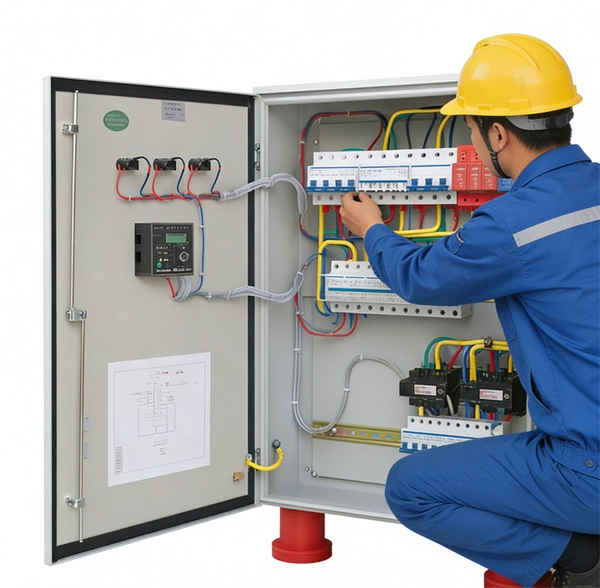
Distribution boxes must be installed in dry, accessible locations, at proper heights, with secure wiring, grounding, and protective devices, following IEC, NEC, or local electrical standards.Site Selection and Environment

Distribution boxes should be installed close to the power supply to minimize power loss and ensure safety. Avoid humid, corrosive, or poorly ventilated areas to prevent overheating and equipment damage. For outdoor installations, ensure the box has an appropriate IP or NEMA rating to protect against water and dust ingress, and place it at least 3 feet above ground to avoid water exposure .

Installation Height and Fixing

The recommended height for wall-mounted boxes is typically 1.4 to 1.8 meters (4.5–5.5 feet) from the floor, making them easily accessible for operation and inspection. Ground-mounted boxes should be raised 2–4 inches to prevent moisture damage. The box must be firmly fixed using suitable brackets or screws to prevent movement due to vibration or accidental impact .

Wiring Specifications
  • Power must be turned off during installation.
  • Use high-temperature resistant copper wires with cross-sectional areas suitable for the expected load.
  • Ensure neat cable management, proper insulation, and clear labeling of wires.
  • All cable inlets and cover joints should be sealed to prevent dust or moisture ingress .
Grounding and Safety Protection
  • The metal enclosure, electrical board, and appliance casings must be properly grounded.
  • Connect the protective neutral wire reliably through a terminal board.
  • Install circuit breakers, fuses, surge protectors, and leakage protectors for each circuit to prevent short circuits, overloads, and electrical hazards .
Compliance with Standards
  • Follow IEC 61439 for low-voltage distribution boxes, which specifies design, testing, and documentation requirements, including temperature rise limits, insulation strength, short-circuit withstand, and mechanical functionality .
  • Adhere to NEC, IEC, or local codes for safe spacing, labeling, and maintenance access.
  • Use UL or CE-certified components to ensure compliance and reliability .
Special Considerations
  • For explosion-proof or industrial environments, follow specific material and grade requirements.
  • Ensure regular inspections and maintenance to detect wear, overheating, or loose connections.
  • Consider modular designs for easier future upgrades and replacements . By following these standards, distribution boxes can provide safe, reliable, and long-lasting electrical distribution, minimizing risks of fire, short circuits, and equipment failure.
Installation Reference Standards for Distribution Boxes

Choose & Install Low Voltage Distribution Boxes Practical Guide

Select and install low voltage distribution boxes . This guide covers sizing, mounting, cable management, maintenance

How to Install a Cable Distribution Box Safely and Correctly?

In modern electrical systems, cable distribution boxes (also known as electrical distribution boxes or distribution

Related Video Reference

This video was associated with the source search result. Verify technical details against current product documentation and project requirements.

Technical note

This reference is intended for preliminary ODN and passive infrastructure research. Topology, split ratio, box or cabinet capacity, closure rating, cable type, test limits and applicable standards must be verified for the specific project.

Still Have a Technical Question?

Use the inquiry form to describe an ODN network, passive component or distribution box question.

Start an Inquiry